
目次
- 1 What Are Attachments in Clear Aligner Treatment?
- 2 Basic Structure of Attachments
- 3 Appearance and Material
- 4 Understanding the Role of Attachments
- 5 How Attachments Move Teeth
- 6 Why Attachments Are Essential in Clear Aligner Treatment
- 7 Types and Characteristics of Attachments
- 8 Differences in Shape
- 9 Important Notes About Attachments
- 10 Why Attachments Come Off
- 11 Daily Care for Attachments
- 12 Summary
What Are Attachments in Clear Aligner Treatment?
Have you heard the word “attachment” before?
Most people are familiar with clear aligner treatment, but today we’d like to take one step further and explain what attachments actually are.
Basic Structure of Attachments
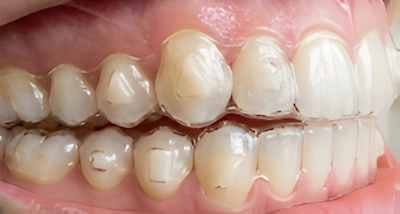
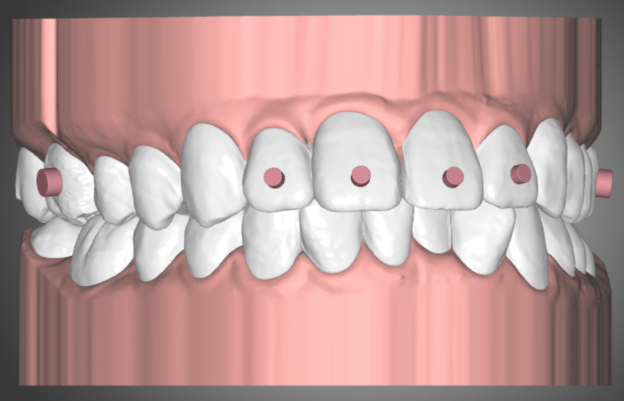
Attachments are small bumps bonded to the surface of your teeth during clear aligner treatment.
You may notice that the aligner itself has corresponding raised areas that match the shape of each attachment (see photo above).
Key characteristics of attachments include:
- Made from tooth-colored dental resin (white composite)
- Blend in naturally with the color of your teeth
- Very small — just a few millimeters in size
- Bonded directly to the tooth surface
Think of them as “handles” that give the aligner something to grip onto.
Imagine trying to hold a smooth glass with a thick glove — it slips easily. But if the glass has a textured surface, you can hold it firmly. Attachments work the same way, giving the aligner precise control over each tooth.
In short, attachments are a critical auxiliary device for transferring the right forces to your teeth.
Appearance and Material
Attachments are designed to be as inconspicuous as possible.
After all, the whole point of choosing clear aligner treatment is to minimize visibility — so aesthetics matter throughout the process.
Their characteristics include:
- White, tooth-colored — blends in naturally
- Small enough to be nearly invisible from a distance
- May be slightly noticeable depending on the angle of light
- Surface has a slightly rough texture
That said, there are a few things to keep in mind:
- They can stain from coffee, curry, and similar foods
- The three-dimensional shape may catch the light and be noticed up close
Even so, attachments are far less visible than traditional wire braces.
This makes clear aligner treatment a great option even for professionals in sales or customer-facing roles.
Understanding the Role of Attachments
So why are attachments necessary? Because aligners alone cannot deliver sufficient force to move teeth as planned.
How Attachments Move Teeth
Simply put, attachments transmit precise forces to push, pull, and rotate teeth in the intended direction.
This is because orthodontic tooth movement is far more complex than simple forward-backward or side-to-side sliding.
The actual movements involved include:
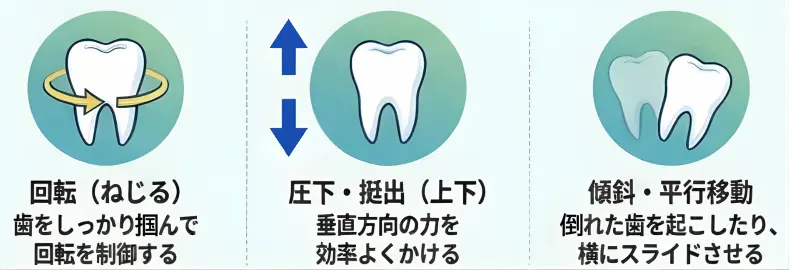
Rotation (twisting)
Intrusion and extrusion (vertical movement)
Tipping (tilting)
Translation (parallel movement) — all of which require complex, targeted force.
Without attachments:
- The aligner slips on the tooth surface
- Force becomes scattered and ineffective
- Teeth do not move as planned
With attachments:
- Force is directed with precision
- Individual teeth can be moved with pinpoint accuracy
- Overall treatment effectiveness improves significantly
Attachments are not just a supplementary feature — they are a precision control system for tooth movement.
Why Attachments Are Essential in Clear Aligner Treatment
Attachments are indispensable for keeping treatment on track.
Without them, aligners alone are limited in the range of cases they can handle.
For example:
Cases requiring significant tooth movement
Teeth with significant rotation or twisting
Situations requiring bite adjustment
In these cases, treatment may not be achievable at all without attachments.
A common scenario we see clinically:
Attachments overlooked or improperly placed → tooth movement goes off course → re-scanning and remaking aligners → treatment timeline extends.
Conversely:
When attachments are placed correctly from the start and aligners are worn as instructed, treatment proceeds smoothly and on schedule.
Attachments should not be thought of as “optional” — they are an essential part of the treatment system.
Types and Characteristics of Attachments
Differences in Shape
Attachments come in various shapes, each chosen for a specific purpose.
The most common shapes are:
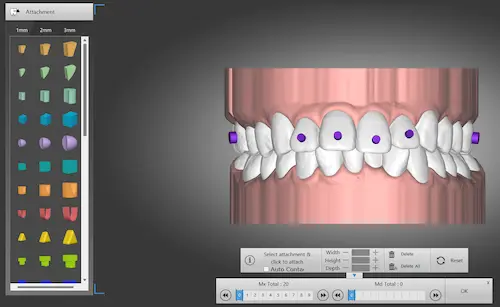
*In reality, attachments are clear to white in color. The colors shown above are used in the treatment planning software for visual differentiation.
- Rectangular (most common)
- Elongated rectangle (strong rotational control)
- Elliptical (suited for fine adjustments)
- Triangular (amplifies force in a specific direction)
- Circular (versatile — handles multiple movement types)
Each shape is selected based on:
- The direction of intended tooth movement
- The location of the tooth in the arch
- The complexity of the movement required
Even if they look similar at a glance, each attachment is placed with a specific purpose and precise positioning.
Important Notes About Attachments
Why Attachments Come Off
Attachments can detach if not handled with care.
Common causes include:
- Removing aligners too forcefully or carelessly
- Biting hard foods with excessive force
- Teeth grinding or clenching (bruxism)
- Poor bonding during placement (can occur even with proper technique)
The most frequent cause is twisting or wrenching the aligner sideways when removing it.
To prevent this:
- Remove the aligner evenly from both sides
- Always remove it slowly and carefully
- Consider using a dedicated aligner removal tool
- Contact your dentist promptly if something feels off
Daily Care for Attachments
Key points for daily care:
- Brush your teeth thoroughly after every meal
- Use dental floss regularly
- Minimize staining foods and drinks (coffee, curry, etc.) when possible
- Schedule regular professional cleanings
Plaque tends to accumulate around attachments, so pay extra attention to cleaning these areas during brushing.
Summary
Attachments are far more than just an add-on component.
They are a vital part of what makes clear aligner treatment work.
Understanding the role of attachments — and caring for them properly — is the key to a successful outcome.